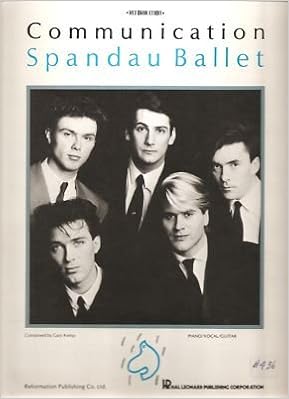
“Communication” by Spandau Ballet, released in 1983
These days technology allows us to communicate quicker and more effectively, but devices don’t take into account human error. Better technology doesn’t guarantee perfect communication 24/7. Communication in day-to-day activities is hard enough. Communication in romantic relationships? Forget it!
In 1983, British group Spandau Ballet hit it big in the U.S. and the U.K. with their song “True,” also the name of their third album. The New Romantic band later released their song “Communication,” but it failed to gain as much momentum as the songs “True” and “Gold.” Written by Gary Kemp, one of the band’s guitarists, “Communication” still has a neat groove and is very poetic, as it tackles the woes of love and communication.
As most ’80s songs, the synthesizers come in loud and clear at the beginning. What strikes me is that this introduction already sounds disjunct. It hurts the ears a little, but it’s still very catchy. For a song about failed communication, the instrumental captures the nature of the song from the very first note!
Tony Hadley’s vocals are never incomplete, but he starts the verse singing about how communication isn’t complete. This line is very direct, and it catches listeners a bit off guard with the idea that communication is incomplete, not whole. After all, humans rely on all forms of communication in order to live. Humans are social beings. Already in this first line, we see how personal the song will become.
The verses of this song pack a punch, as they are the most poetic (which also means that I’m apt to read into them way too much!). The alliteration of “grass is greener, but it always grows” guides the listener along, and provides familiar imagery. The rest of the first verse expands on how communication is incomplete, and how the singer (persona Hadley is singing) and his lover aren’t on the same page. She’ll never be able to reciprocate this communication, these “love messages.”
And now he’s alone. “Communication let me down” feels very universal. It’s a message that resonates and hits home, no matter what type of failed communication listeners are experiencing. At the same time, Hadley’s voice doesn’t sound like it’s full of despair over his being left behind, at least not yet. Instead, this chorus feels a little light-hearted; it’s not a matter of life and death.
Okay, you got me: I had to look up what a Telex was (if you don’t know either, click here: https://www.askdifference.com/telex-vs-fax/). The second verse kicks off with the idea that whether a message is sent through a Telex machine (like a text) or spoken, the singer isn’t receiving messages directly. By hearing things second-hand, he has no way of knowing what’s true. Is he hearing everything he needs to hear?
The singer even admits to being incognito. If his identity is hidden, then he isn’t accurately communicating his real self either! It seems that he might be both a victim and an instigator–but mostly a victim. Without a rendezvous, he can’t even meet to clear up any miscommunications! As he continues, he grows more frustrated with communication failures. Who can blame him!
The bridge of the song is the climax of communication troubles. Now he’s waiting by the phone, but the phone can only create more problems. He realizes that he can’t spend time cleaning his heart up and fixing what communication damaged. Love just isn’t worth it.
Talk is Cheap
Spandau Ballet’s “Communication” shows us that communication is flawed, and sometimes it just isn’t worth the trouble. Yet, to be human is to communicate, so giving up communication isn’t exactly an option. Changing how we use communication, though, may help. If we say what we mean and follow through on our promises, then we will be on track toward communication that is whole, not incomplete.
Before You Go…
Be sure to listen to and follow my Spotify playlist dedicated to the songs featured on Monthly Mixtape. Every month I add the new song I review to the playlist. Check it out below!
Do you feel slightly insane? Don’t worry, you can’t feel any crazier than the residents of the Twilight Zone. Well, maybe you can…
Every New Year’s, the SyFy channel airs a Twilight Zone marathon (the originals, from 1959-1964), and it’s one of my favorite holiday traditions! This year, while binging the classic episodes, I mulled over one common theme that most of the stories share: individual sees/experiences something that no one else does. Obviously, that person is crazy. What makes the Twilight Zone so mesmerizing is that we, the audience, also get dragged into the Twilight Zone. We, too, are just as crazy as the main characters because we see what they see.
To take a deeper look at this effect, I’d like to analyze two episodes: “Mirror Image” and the famous “Nightmare at 20,000 Feet.”
“Mirror Image”
Millicent Barnes (Vera Miles) sees herself sitting in the bus station while she is standing in the restroom.
While waiting for a bus, Millicent Barnes (Vera Miles) soon begins to think she’s losing her mind. When she asks the clerk how much longer until her bus arrives, he annoyedly tells her that she just asked him that question a couple of minutes ago. Flabbergasted, Millicent asserts that she’s done no such thing. Then, she asks about her suitcase, which is near the clerk’s desk. She demands to know why her luggage was moved there, but she receives no helpful answer. After she sits back down on the bench for a moments, she glances down to find her suitcase on the floor beside her.
Immediately, Millicent’s sanity is questioned by the viewer and the other characters. The clerk, of course, thinks she’s nuts because he doesn’t see the strange occurrence she does. On the other hand, we see what Millicent sees. We’re not sure what to make of the suitcase, because, like her, we’ve seen it in both locations. We step into her point of view, and we even start to question our own sanity. Who do we believe: Millicent or the clerk?
But things grow worse for Millicent. She decides to go into the restroom, where she also finds another lady. The lady mentions that Millicent was just in the restroom. How could that be, since we haven’t seen her in the restroom until now? But when she looks in the bathroom mirror, she sees an image of herself also sitting on the bench outside. Quite simply, poor Millicent is seeing double, and so are we! We can’t make sense out of any of these creepy instances, unlike the lady in the restroom who only sees one side of the story.
We’re not dreaming or making things up when another traveler enters the bus station. Paul Grinstead (Martin Milner) meets Millicent, and soon they are talking about what she’s been seeing. He keeps her calm, all until their bus finally arrives. The two travelers step outside, and that’s when Millicent finds her double again, this time sitting in a bus seat. Naturally, she faints. We probably would too, if we were in her situation!
Paul decides to miss his bus and stay with Millicent at the station. Searching for an explanation, Millicent concludes that the double she’s seeing must be from a parallel universe. Paul remains kind, despite his internal doubt. He mentions that his friend, who has a car, lives nearby and that he’ll give him a call. As a viewer, our joint point of view with Millicent is shifted when Paul heads over to use the clerk’s telephone. He tells the clerk that he’s actually calling the police (but isn’t he from Adam-12?! 😄). Here our sense of reality is really fractured, and we’re not sure if Millicent is crazy, or if Paul is going to get his, even though he is a nice guy.
Paul Grinstead (Martin Milner) meets his double!
Once the police arrive and haul a frantic Millicent away, we are left with Paul’s point of view. There is a silence in this moment, a silence where we, the audience, wait with baited breath. What just happened? If Millicent was right, then we are also right, and we’re sane. If Paul was right, then we’ve been just as duped as Millicent. But when Paul meets his double in the final scene, he’s just as freaked out as we’ve been all along. Now we know that we’re not crazy, but we get an even eerie feeling knowing that we’re right. What’s worse: acknowledgment of the terrifying truth, or the realization that no one is going to believe us? Well, at least Millicent and Paul won’t think we’re crazy. But how do we escape the Twilight Zone?!
“Nightmare at 20,000 Feet”
Captain Kirk is not okay. William Shatner plays Bob Wilson, who just finished his time in rehab recovering from a nervous breakdown. The beginning of the classic episode shows Bob and his wife Julia (Christine White) boarding the plane. Julia asks Bob if she should take the window seat, but Bob “mans up” and settles into the window seat, which is conveniently adjacent to the emergency window.
The flight takes off, and we think Bob is doing fine. In fact, he is, until he has trouble sleeping. He ends up looking out the plane window and spies something moving on the plane’s wing. He tries to see it better through the rain. No one else sees anything out the window, but Bob’s not necessarily crazy yet. Like with Millicent, we see what Bob sees, so now we’re left to wonder whether we’re seeing things, or if there is gremlin on the wing of the plane.
The creepiest moment of the episode is when Bob lifts the blind and sees the gremlin’s horrifying face pressed up against the glass while the rain hits hard. How can we not get dragged into Bob’s psyche? We’re victims of his mind just as much as he is!
Bob Wilson (William Shatner) is the only one to see the gremlin out his plane window.
Needless to say, no one but Bob and the viewer sees the gremlin tear apart the wing of the plane. Not the stewardess, not Bob’s wife, and surely not the pilot. In fact, the pilot plays along with Bob’s story, admitting they’ve known about the gremlin. Bob, with the bits of sanity he has left (or maybe has never lost), becomes angry with the pilot for playing along. Bob, of course, knows what he’s seeing, and so do we. We don’t need the pilot to play along now and throw us in the loony bin later!
Eventually, Bob can’t take it anymore. He can’t just sit and watch while the ugly gremlin hijacks the plane. So, he steals a gun and opens the emergency window, his body getting sucked outside by the wind and rain. He shoots at the gremlin while others try to pull him back inside.
Because of Bob’s gremlin nonsense, the plane lands, and Bob has to go back to rehab. But before he’s taken away, we see a shot of the wing of the plane that’s been torn apart. Maybe the gremlin existed after all. Maybe Bob isn’t crazy, and neither are we. We have our proof.
Which Dimension is This?
At the end of the day, we can leave the Twilight Zone practically unscathed, and we can sympathize with the unfortunate protagonists because we’ve seen what they’ve seen.
The Twilight Zone is a thrill because it drags us in and makes us part of the horror and strangeness; but it’s also a “place” we can leave. We can try to forget mirror images of ourselves and furry gremlins. We become crazy for a few moments, but then we are allowed to escape. Or are we? Only in the Twilight Zone!
Needless to say, we’re all more than ready for this new year, one that will be full of light and optimism. During 2021, my mission is to continue uniting all old souls through a variety of classic subjects and posts. COACS was inspired by a magazine I created for a college class; I enjoyed writing about my favorite topics, especially those that showcase my own old soul. One year and thirty-six blog posts later, I still have a range of old soul topics that I’m itching to dive into.
COACS aims to appeal to all old souls, no matter what age. The variety COACS offers ensures that all readers and old souls are welcome to take part in appreciating the past and bringing that past into the present.
Here is what COACS has to offer this year!
New Segments
Take a look at the new types of posts COACS will feature in 2021:
True Confessions of a Classic Soul: In these posts, I’ll give away some of my own personal “old soul” secrets. Did you know that I used to not like black and white TV shows?
Old School Gallery of the Month: On the “A Touch of Old School” page, you’ll find a photo gallery of classic objects that we still cherish and keep in our homes. This year, we’ll compile photos under a monthly theme. For example, one month could simply feature photos of old clocks. This segment will provide a great opportunity for readers to share and showcase their own cherished items.
More Old Soul Features: As requested by readers, I will write more posts that emphasize the characteristics, values, and traditions of old souls.
Don’t worry, you’ll still be able to read these usual types of posts as well:
Monthly Mixtapes
Movie/TV Reviews
Book Reviews
Recipes
Comparison Posts
Lists
And much more!
Staying in Touch
You are a part of COACS just as much as I am, so let’s stay in touch in 2021! On the “Stay in Touch” page, you can find ways to stay up-to-date with posts and suggest topics you’d like to see featured on COACS. You can even take the “Your COACS Reading Experience” survey to make your voice heard regarding the posts you like reading. By completing this survey, I will gain a better sense of what you value most in COACS. Additionally, you can sign-up for my email list, which will keep you updated on COACS posts, as well as other writing projects I am working on as an author.
Later in the year, you will also be able to request COACS and Nicole Fratrich-Author merchandise. For the time being, these products will be at no cost to you, so get ready to show your support with stickers, bookmarks, and business cards!
As Always, Stay Tuned!
I cannot thank you enough for your support. Your readership means the world to me, and I love that I can share my old soul with you. If you know of someone who would be interested in reading COACS, please, spread the word! Let’s reach as many old souls as possible this year!
Stay tuned for new posts! I’m ready to start rolling, are you?
According to dictionary.com, a resolution is 1) “a solution, accommodation, or settling of a problem” and 2) “the mental state or quality of being resolved or resolute.” Each year, we decide which problems or bad habits we’d like to fix about ourselves. At the same time, a “New Year’s resolution” requires us to have a strong will and lots of determination in order to actually stick with the resolution. Yet each year we stray and have trouble succeeding at our own personal goals. This conflict is due to our being hopelessly human.
Old souls approach life differently than others, so it only makes sense that old souls create their New Year’s resolutions in a unique manner, based on specific values and preferences. No two old souls approach resolutions in the same way, of course, but what follows is an old soul’s guide to New Year’s resolution-making. After all, I’ve been making resolution contracts with myself for the past several years.
While I can’t solve the problem of straying from resolutions, I can at least provide encouragement and a few helpful tips!
To help focus and inspire your resolutions, you may want to create a theme for “your year.” This theme will be your personal motto and will encourage you to stick with your resolutions. Selecting the theme, however, is entirely up to you. Try to keep it as personal as possible, even if it’s a mantra that doesn’t mean anything to anyone else!
Nicole’s Approach: Being the music lover that I am, I like to base my theme on songs. 2019 was my “Whatever It Takes” year while 2020 was my “Never Surrender” year. 2021 will be my “Freedom” year.
2. Focus on the Big and the Small
While having a theme will help you set your perspective on the year, you want to make sure that you create both overarching goals and smaller, focused goals. The big goal may take you the entire year to accomplish, or it may not turn out quite like you hoped. Smaller goals complement these larger goals and help you feel more successful when larger goals take longer to achieve. Remember, whether you succeed or fall short on any of your goals, progress is what truly matters. If you try your best and make even the tiniest bit of progress, then your resolution isn’t null and void!
Nicole’s Approach: I usually come up with a combination of smaller and larger goals. For example, my overarching aspiration might be “work on publishing the novel,” while a smaller, focused goal might be, “keep in touch with family and friends through cards, texts, email, etc.”
3. Write Down Your Resolutions
Old souls like to think things through before they commit to doing something. So, as you think through your New Year’s resolution(s), you may want to jot everything down on paper, a Word document, a notecard, or even in a planner. The point is, you’ll have thought through your ideas, and you can look back at them anytime of the year. The written record of your resolution will also inspire you if and when you grow discouraged. Plus, studies prove that you are more likely to remember information if you handwrite it on paper. So, by writing down your resolutions, you just may be more likely to follow through with them!
Nicole’s Approach: For the past few years, I’ve written my resolutions on a Word document, and I write them as a contract with myself. Of course, you don’t have to sign a personal contract with yourself, but it might encourage you to stay on track! Since old souls are loyal, they will likely stick to a signed agreement with themselves!
Don’t be afraid to create the resolutions you really need to make you happier in the new year. If you need to find a way to cut back on a habit or schedule extra time for yourself at the end of the day, then DO IT! If you’re an introverted old soul (many old souls are), then you want to pick the best resolutions for yourself, even if they seem a little scary. At the end of the year, it’s okay if you didn’t succeed in accomplishing an entire goal. I hope Yoda forgives me, but it really is okay if you only “try” and don’t completely “do.”
Nicole’s Approach: This year, I plan on creating a rotating schedule for myself so I take time to read, write, and publish regularly.
5. Make Time to Learn Something New
Old souls also love to learn new things, so why not incorporate learning into your resolution! If you love classics, like most old souls, then you may want to pick out one topic or historical person of interest and dive into some personal research. You may as well explore your own intellectual pursuits. Why not? No one said that all resolutions have to be hard. You can resolve to educate yourself in something you’re interested in!
Nicole’s Approach: Last year I took on a few of my own research projects, including research on actors and musicians. At the beginning of the year, I never expected that I would fall head first into these projects; I’m sure glad that I did!
Whether you classify yourself as an old soul or not, it isn’t too late to think about New Year’s resolutions. You can even change them throughout the year. In an case, resolutions don’t have to be daunting. You can always take them step-by-step and work on them at your own pace. Here’s to a happier you in 2021!
Join the Discussion!
How do you feel about making and keeping New Year’s resolutions?
Each year, I write a short Christmas story and share it with my readers. At first I only posted these stories on Facebook and Instagram, but, this year, I am able to share my story right here on Confessions of a Classic Soul. Typically I break up the story into three installments and share them over the course of the weeks leading to Christmas Day. This year, however, I’m going to post the entire story–no need to wait in suspense!
This year’s short story is about Elias, who wants nothing more than to go inside the lighthouse in his town, even if it is almost Christmas. Amid wonder and tragedy, faith plays a key role in this heartwarming story. Enjoy!
Elias and His Christmas Lighthouse
  "Don't play near the lighthouse today!" Alice shouted after Elias.

  But Elias barely heard his mother as he dashed out the door and into the town. His boots crunched on the snow that had fallen a few days ago, and he passed the ice skaters dancing and slipping on the frozen pond. Skipping across the bridge and into the main part of town, Elias looked about and took in the wonder around him. Christmas was only two days away, and the town was festive, as always: wreaths hung on the front of the firehouse, bells and angels decorated the cathedral, and multi-colored lights twinkled in the park.

  Yule Harbor wasn't a heavily populated town, but it did very well for itself, especially with the number of fishermen who earned a living from the local waters.

  Elias loved to watch the comings and goings on the dock. Most importantly, he loved to watch the lighthouse that guided the boats. Since it was Christmastime, the lighthouse glowed red at night.

  No matter how many times he had tried, Elias had never successfully made his way to the top of the lighthouse. That day, however, he was determined to make it to the top. It was a sort of Christmas present he wanted to give to himself.
  After spending days watching the hustle and bustle on the dock, Elias knew when workers would be nearby and when they wouldn't be. Sadly, Elias also knew that he wouldn't be able to try and sneak his way into the lighthouse until at least lunchtime, early evening at best.

  So, he spent the morning sitting on the dock, watching the boats come in. In the afternoon, he chatted with some of the workers, many of whom were family friends.

  "You're not still obsessing over that lighthouse, are you Elias? It's not a safe place for a boy like yourself. You just stay away from there." Roger, an elderly dock-worker, squinted at Elias.

  Roger always reminded Elias of safety rules whenever Elias would hang around the dock.

  Elias shook his head. "No, sir," he said politely.

  When Roger turned away to help a boat that had just made port, Elias smirked to himself and sped off toward the lighthouse. It was almost time for his chance to sneak inside.

  Tilting his head back to catch a full glimpse of it, Elias took in the massive lighthouse. The lighthouse was made of dark gray brick. The door was painted bright red, and a plaque above the door frame read "Yule Harbor" in scribbly cursive. A few windows were scattered around the lighthouse. Elias loved pretending that he was a prisoner looking out the windows, wracking his brain to find a way to escape.

  Now the waiting game. Elias decided to hide among the bushes outside of the lighthouse. One of Elias' favorite games was "spy." He loved disguising himself and watching the world around him.

  Finally, Mr. Hanover, the keeper of the lighthouse, opened the red door and stepped outside. As he dug a key from his pocket, Elias' heart sank. Elias forgot that Mr. Hanover always locked the door to the lighthouse. He was hoping that he could sneak through the door after Mr. Hanover left for home.

  Just as Mr. Hanover was inserting the key into the lock, Roger called out to him.

  "Have you seen Elias around here, today?" Roger asked.

  Mr. Hanover turned away from the door and strolled over to talk to Roger. "No, why? Is he still trying to take a peek inside the lighthouse?"

  Roger nodded. "That kid's going to get himself into trouble."

  "Well," Mr. Hanover said, "Maybe I should just give him a tour one day. Elias means well."

  As Mr. Hanover and Roger were talking, Elias made his move. He sprinted from his spot behind the bushes and pushed through the lighthouse door.

  Whew! Elias couldn't believe he had done it. He scanned the bottom of the lighthouse, and all he found were some barrels, two windows one either side, and a long, spiral staircase. But Elias was excited at what he saw. His mind was full of questions! He started to walk around the first floor when, suddenly, he heard a soft click from the door. Elias held his breath, waiting for Mr. Hanover to catch him in the act. Instead, he heard footsteps retreating from the door. He was locked inside the lighthouse.
  At first Elias was nervous. Now he'd have to stay inside the lighthouse all night without any supper. His mother would be worried sick, and Mr. Hanover would likely scold him in the morning. But then Elias tried to think positively. He had the whole lighthouse to himself! Besides, he knew his mother worked very hard to support him; maybe his being in the lighthouse would give her a much-needed break.

  Elias played for a while on the bottom floor, pretending that he to be a spy locked in a tower. Eventually, though, he grew bored. The sun was almost over the horizon, and he was starting to get cold. But he hadn't made his way to the top yet!

  Despite his young legs, he had to keep stopping on the long staircase. So many steps! He took his time, looking around every time he stopped. He still couldn't believe he had managed to get inside.

  The view was worth it. Elias, mesmerized by the red light, stood in awe at the top of the stairs. Slowly, he moved his way inward and looked out the top windows. The water below swayed gently, and there were no boats about. A slight breeze blew in through the window, and Elias shivered. But he was no longer scared. The view was gorgeous.

  The quiet night comforted Elias. He wondered if it was this quiet on the night Jesus was born. Christmas. He thought about his mother again. She had been working long days at the local department store, especially during the holidays, and Elias wished he could give her a nice Christmas. Maybe Mr. Hanover would let him bring his mother up here to admire the view. Yes, he decided, that would be the best Christmas gift he could give her.

  Just then, Elias noticed that the sky had cleared to reveal dozens of stars. One big star caught his attention, leaving him to wonder if it was similar to the Christmas star. He ran to the nearest window and poked his head out. He didn't realize that he kept inching farther out the window as he gazed at the star. Suddenly he was falling.

  He tried to hold onto the window frame, but he couldn't get a firm grip. He was falling straight into the water.
*** Alice blamed herself. She should've made sure that Elias was safe. She shouldn't have been so hard on him. Then maybe he wouldn't have snuck in to the lighthouse. Deep down she knew she couldn't blame herself too deeply. Sometimes accidents happen. Still...
Mr. Hanover lived near the lighthouse, and he had heard a noise that sounded like a yell. He also thought he heard a great splash.
The emergency crews sped to the scene, and the search for Elias was underway. Men gathered in boats and began scouring the water.
"Can Elias swim?" an officer asked Alice.
Shaking, Alice answered, "He took swimming lessons a few years ago, but I don't know if he could swim through water like this."
The wind had begun to pick up, and a storm was coming.
The crews searched for Elias day and night, but they couldn't find him. Alice stood by the entire time, helping in any way that she could. Friends and community members came to support her, and they sent up tents with food for everyone involved in the search.
She was a horrible mother. Yes, that must be it. It was the only conclusion Alice could come up with. She should've been more attentive. Instead, she chose to work the extra hours at the department store in order to take Christmas Eve off so she and Elias could attend Mass at the cathedral. If she had taken the night off, then maybe none of this would've been happening.
Alice didn't see herself as a struggling single-mother. On the contrary, she devoted every minute she could to supporting her two-person family. But as the crews combed every inch of the water, Alice felt helpless. She had failed, hadn't she? The one time her devotion was in the wrong place, she risked losing Elias.
Through the constant tears, Alice also smiled weakly from time to time. Elias loved adventures, and the lighthouse was always on his mind. He was curious, and he did his best to help his mother when he could. He was eager and loving.
  On Christmas Eve, the search for Elias had to stop, at least until after the holiday. The emergency crew wearily trudged through town, their faces stained with disappointment. There wasn't much they could do.

   Alice was torn. She had no motivation to attend Christmas Eve Mass. What was there to celebrate? Her only son might never be found. Was he still alive? No, she couldn't let her thoughts turn to the worst case scenario. Elias was a fighter. He had to still be alive. Yet doubt still lingered in her mind.

  A neighbor persuaded Alice to go to church with her. Hesitantly, Alice agreed, but she almost lost all composure she had when she laid eyes on the beautifully decorated church. How could such beauty bring sad tears?

  All throughout Mass, Alice's eyes remained fixed on the nativity. She barely listened to a word the priest had said. She just couldn't stop staring at the baby Jesus; where was her baby? Why did all her light and joy have to be taken from her? It just wasn't fair. She had tried her best to be a good mother; what if all the hard work just wasn't enough? With tears streaming from her face, she sat in the pew, hoping that the rest of the congregation wasn't looking at her.

  At the very end of the Mass, as the priest sat silently before saying the final prayer, the heavy churched door opened, and one of the firemen quietly entered. A few churchgoers whispered to on another, but Alice only sat with her eyes closed. She didn't see Jim enter, but she did hear his voice in her ear.

  "Alice, we found him. A fisherman found him on the way back to the dock."

  There was a pause, and Alice's stomach tightened. She prepared herself for the devastating news.

   "He's alive, and he's outside."

   As if in a trance, Alice slowly stood up and followed Jim out of the church. The parishioners, of course, turned in their pews to watch.

   Right outside the church, the EMTs had Elias on a stretcher. He was weak, but his eyes lit up when Alice came to him.

   "Mom, I'm sorry," he said hoarsely.

    Alice's mournful tears had turned joyful. All she could do was smile at Elias. "I'm not mad at you, sweetheart; I'm just so glad you're okay."

    "The lighthouse is so pretty, Mom. And the view is breathtaking. Maybe we can go there sometime!"

     This was her son, eager for another adventure. She couldn't stop smiling.

     "Just rest," she told him.

     "He seems to be okay from what we can tell," Jim said to Alice. "But we'll take him to the hospital where the doctors can check him out."

      Alice nodded, still smiling. She watched the EMTs load Elias into an ambulance. As they did, she could hear Elias babbling away to them about the lighthouse.

      Before leaving, Jim came back over to Alice. "You know," he said, "for a kid who has been in the water for two days, he still has a lot of energy. He hasn't stopped talking! But there's one thing he's been talking about, even more than the lighthouse--you. He told us all about how you work so hard to take care of him. He loves you a lot."

      "And I love him even more."

      As the ambulance pulled away, a light snow began to fall. Alice glanced at the lighthouse, glowing with its red light. It was beautiful. So was God. And so was Elias.
The Monkees performing “Riu Chiu” on their Christmas episode.
The Monkees’ Christmas episode is full of typical cheesy antics as the guys attempt to help a boy find Christmas spirit. At the end of the episode, Micky, Davy, Mike, and Peter perform a version of the Spanish song “Riu Chiu.” The song, which is about the Blessed Virgin Mary and birth of Jesus, shows a serious side of the Monkees. Not only do they sing the song in Spanish, but they sing it in a round, showcasing the unique blend of their voices. In fact, it’s one of very few songs on which all four of their voices are featured.
“Riu Chiu”
Before diving into my review of this song, I just want to note that the translations from Spanish to English seem to vary depending on the source. Despite the slight differences, the general meaning of the Spanish villancico remains the same, and it’s beautiful. The translated version I’m using is from azlyrics.com.
CHORUS:
(Spanish)
Riu riu chiu, la guarda ribera;
Dios guardo el lobo de nuestra cordera,
Dios guardo el lobo de neustra cordera.

(English)
River, roaring river, guard our homes in safety,
God has kept the black wolf from our lamb, our Lady.
God has kept the black wolf from our lamb, our Lady.
Mike starts off the song and begins the round. Peter soon joins Mike, and then Davy and Micky enter. The song itself sounds like a lullaby, allowing it to fit in perfectly with Christmas hymns. Notice that all four voices don’t overpower the gentle melody; instead, they reinforce the chorus, almost like a prayer or chant. The message grows stronger as a result of all four Monkees.
Simply, God protects Mary, our Lady, so Jesus, the lamb, is also safe. In the Catholic Church, Mary, like Jesus, was born without original sin. The black wolf then, symbolizes sin and Satan, and God protects both Jesus and Mary from the power of sin and evil.
Nature plays a great role in this song so far, namely the roaring river and black wolf. These nature (and even pastoral) images are simple and relatable. They are calming, but they are also accessible. God is within our grasp, and we can understand what He has done for us through these images.
VERSE 1:

(Spanish)
El lobo rabioso la quiso morder,
Mas Dios poderoso la supo defender;
Quisola hazer que no pudiese pecar,
Ni aun original esta Virgen no tuviera.

(English)
Raging mad to bite her, there the wolf did steal,
But our God Almighty defended her with zeal.
Pure He wished to keep Her so She could never sin,
That first sin of man never touched the Virgin sainted.
Micky sings both verses, and I’m so glad that he does. As a Monkees fan, I’ve heard different sides of Micky’s voice. Sometimes there is a nice rock edge to his voice, as with songs like “(I’m Not Your) Steppin’ Stone” and “Goin’ Down.” On the other hand, Micky is great with softer songs, and his voice is very comforting on songs such as “Take a Giant Step” and “Sometime in the Morning.” So, “Riu Chiu” is just another example of Micky’s range and vocal capabilities. Also, his ability to sing Spanish and nail the accent is also pretty cool!
The first verse reinforces the idea that God protects and defends Mary. The wolf, meaning Satan, naturally doesn’t like Mary’s purity. Similar to when the angel says, “Hail Mary, full of grace, the Lord is with thee,” this song echoes the message that God favors Mary and will look after her.
The translation is full of rich, descriptive language that makes the song really stand out. Words like “sainted,” “pure,” and “zeal” speak to God’s love for Mary.
VERSE 2:

(Spanish)
Este qu'es nacido es el gran monarca,
Christo patriarca de carne vestido;
Hemos redemido con se hazer chiquito,
Aunqu'era infinito, finito se hiziera.

(English)
He who's now begotten is our mighty Monarch,
Christ, our Holy Father, in human flesh embodied.
He has brought atonement by being born so humble,
Though He is immortal, as mortal was created.
The second verse is the same in terms of how Micky sings it. This verse, however, now focuses on the true meaning of Christmas: the birth of Christ. I really like the translated “mighty Monarch.” The alliteration sticks in your head. Here the familiar story of God made flesh is told through a lullaby-like melody. Words like “atonement,” “humble,” and “embodied” feel biblical, but they really draw attention to the beauty of what Christians celebrate this time of year.
Of course, the repetition of the chorus at the end adds the last touches to the song. The round continues, crisp, yet not too bold. The last note resolves the song and gives it a big finish.
Pre-Fabricated, Eh?
The Monkees are sometimes seen as simply a manufactured version of the Beatles. And while they may be in some cases, “Riu Chiu” demonstrates that the Monkees were able to sing–and seriously, too. The Monkees were able to step away from the “fictional band” label and produce their own music. “Riu Chiu” was a stepping stone (pun intended) that proved the Monkees had talent and weren’t simply stars in a TV sitcom; in their time as the Monkees, Mike, Peter, Davy, and Micky began to write some of their own music (especially with their album, Headquarters), and, of course, play some of their own instruments!
“Riu Chiu” will make a perfect addition to your Christmas playlist! Where else can you hear a blend of voices from Texas, D.C., California, and Manchester?
Before You Go…
Be sure to check out and follow my Spotify playlist of all the songs I feature on Monthly Mixtape. I know the playlist still looks small, but a new song is added every month. It’s growing!
Throw the rice! No, wait, that’s not right. It’s Christmas, not a wedding! Every Christmas, Grandma Helen baked Totos, a type of Italian wedding cookie. These chocolate spice cookies are topped with a light, sweet glaze that make them irresistible. They’re great with milk, or any beverage, and they add a festive touch to any cookie platter.
So without further ado, here is Grandma Helen’s recipe. Just a note: I’ve seen different versions of this recipe out there, but there isn’t a right or wrong way to make them!
Ingredients
6 cups of flour
2 cups of sugar
2 teaspoons of baking powder
1/2 teaspoon of baking soda
2 cups of milk
1 cup of cocoa
1 teaspoon of allspice
1 teaspoon of cinnamon
1 cup of Crisco all-vegetable shortening (can substitute with butter but will make dough even softer)
1 cup of walnuts (optional)
Glaze
1 cup of powdered sugar (amount varies, depending on how thick you want your glaze)
1/2 cup warm milk OR warm water
Sprinkles, if desired
Steps
Mix all of the dry ingredients in a large bowl. You can start by mixing with a wooden spoon, etc., but you will eventually have to mix the dough by hand.
Add the Crisco or butter and mix well. Note on the Crisco: it’s not the healthiest option, but your dough will not be as soft. This year, we substituted with softened margarine, which made the dough very hard to roll. We had to keep adding flour until the dough thickened enough to roll into a ball. Either ingredient will work, but it is your preference.
Add milk and walnuts; mix well.
By now, you will likely have to get your hands dirty and mix the dough by hand. To help make your dough firmer, whether you use Crisco or margarine, you will likely have to add some flour to help thicken the dough. Your dough should be shiny. No, really, it should look shiny (hence, why my uncle and I started a running joke about shiny cookie dough). Keep mixing until you are able to roll the dough into a ball. You can chill the dough if necessary.
When you roll your dough, you should strive for walnut-sized cookies. Ultimately, you can make them bigger or smaller, depending on your preference. Place each ball on a cookie sheet, about two-inches apart. I suggest lining your cookie trays with parchment paper.
Bake at 375-degrees for about ten-to-twelve minutes.
When your cookies are cooled, it’s time to glaze them! In a small bowl, combine the powdered sugar and warm milk (or water). You can add powdered sugar if you’d like the glaze to be thicker.
To ice the cookies, you can either dip each cookie in the glaze and wait for the excess to drip off into the bowl, or you can simply use a knife to spread the icing. I suggest setting the cookies on wax paper until the icing dries. The icing tends to drip down the sides of the cookies.
Add sprinkles on top of the cookies, if desired.
And that’s all there is to it! The recipe makes about five dozen, which is likely why they are great for weddings. No matter when you make them, Totos are a chocolatey favorite. If you make them for Christmas, you may even still have them for Easter! When you think of Totos, don’t think of a dog in Oz or of an ’80s band. Instead, think cookies!
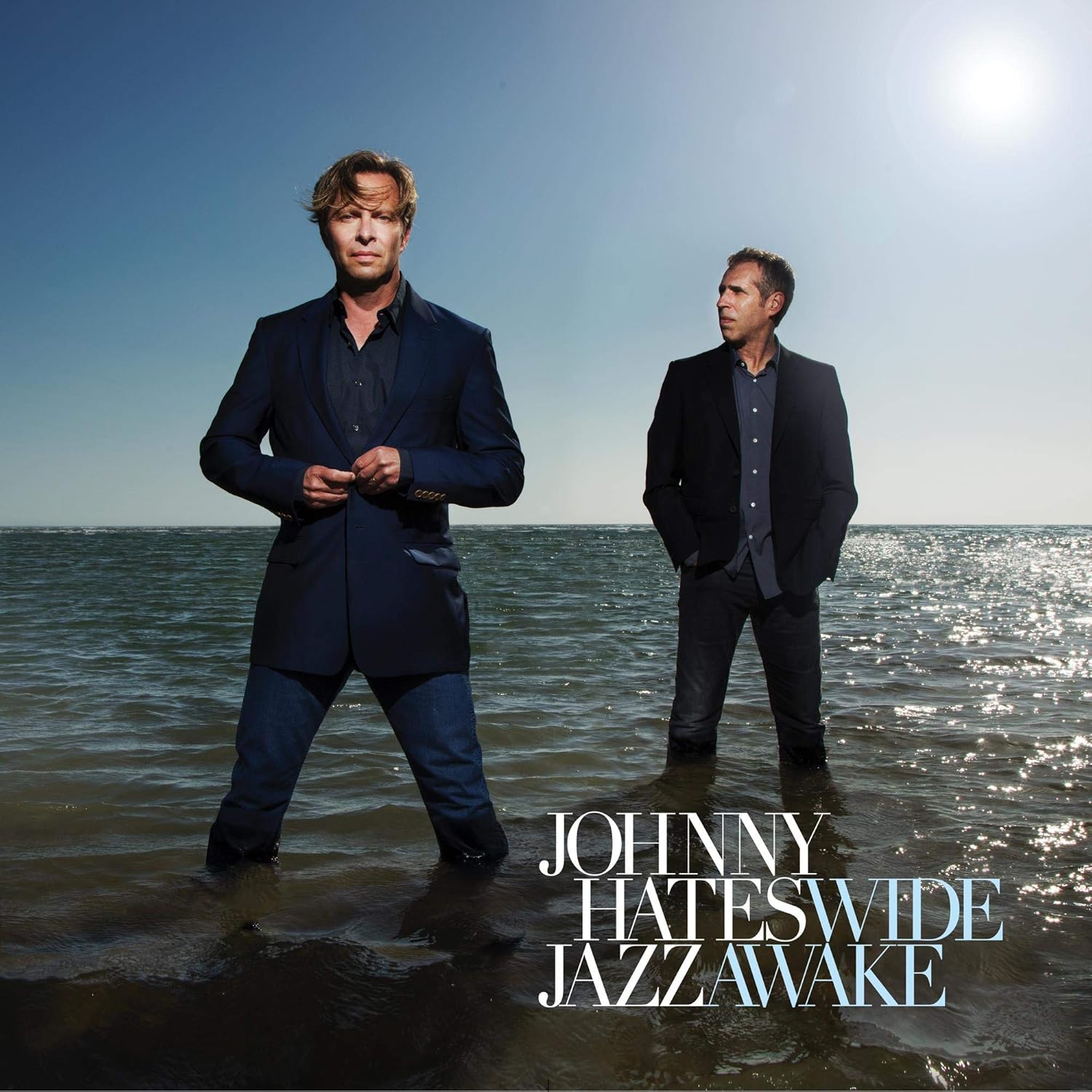
Johnny Hates Jazz released their new album, Wide Awake in August 2020
Beyond “Shattered Dreams”
You and I don’t need a reminder that 2020 has been an extremely difficult year. Right now we need both inspiration and an escape as we close out 2020 and push forward into the new year. Art has always been a saving grace, but perhaps no artistic medium speaks for the human race quite like music. In these challenging times, we turn to our favorite vocalists, guitarists, and songwriters. At the end of the day, music provides us with both a realistic landscape and an escapist paradise.
This year, I am very grateful for an album of songs that has been stuck in my head ever since I carefully slid the CD out of the autographed, environmentally-friendly album case. The aptly titled Wide Awake from Johnny Hates Jazz is hauntingly relevant for its time and so lyrically-crafted that it is simply irresistible. The songs tackle many themes, from saving the environment to the need for music itself.
In 2020, when most of the artistic industries delayed innumerable projects, Johnny Hates Jazz (JHJ) was able to release their fourth album. ’80s music aficionados will know and remember JHJ for their 1987 album, Shattered Dreams. The title track went to number two on the US Billboard charts. Other songs off the band’s debut album include “Turn Back the Clock” and “I Don’t Want to Be a Hero” (Don’t worry, I’ll break down this album in future blog posts!). Back then, the band’s electronic sound fit so well with the time period, but JHJ also had a unique sound all their own, with fresh rhythms and instrumentation, making them stand out above their music peers. Today, Clark Datchler and Mike Nocito continue to produce music that is stylistically and lyrically Johnny Hates Jazz. Their songs blend the good old days with contemporary elements, making their songs just as catchy, vibrant, and ear-worm worthy as their tracks from the late ’80s.
I can’t emphasize enough that Wide Awake is fresh and relevant. Yet it’s not preachy, and it provides a balanced listening of light, heavy, and in-between. As many readers know, each month I review a forgotten or underappreciated song from the past on a feature I call “Monthly Mixtape.” Wide Awake is current, but I fear it may go overlooked, especially by young music lovers like myself. So this Monthly Mixtape review covers the entire album, but we’ll shine a particular spotlight on the song “Wide Awake.”
1. Spirit of Love”
This song feels so familiar, and that is why the song resonates so much and gets stuck in your head. The upbeat soul background provides an interesting juxtaposition to the message of the song: we need the spirit of love. In the first verse, Datchler speaks of pain and hate, although the music is bouncy (and dare I say a bit jazzy?). This contrast gives the song a powerful call to action right off the bat. The hopeful, lighter tones push the song into an anthem.
By the time Datchler hits the chorus, we literally feel the “spirit of love.” The reasons for negative energy are directly stated, but the song’s goal is to do away with the depression, not feed into it.
As the song progresses, it almost sounds cinematic, and Datchler’s emotion promotes that sound. While the verses mirror his pain at seeing the wounded world, the chorus explodes with his optimism. The song not only delivers a sense of realism, but it gives us an uplifting escape. We escape into the song and then emerge with much-needed inspiration. The contrast keeps us “wide awake.”
Is the song stuck in your head now? Good, that’s the point!
2. “New Day Ahead”
When I first heard “New Day Ahead,” I was surprised at the sound. The song, though clearly still JHJ, has a deep rock edge to it that I wasn’t expecting. And just like “Spirit of Love,” this sound is exactly what is needed in order for Datchler to get his point across.
Again, the song isn’t preachy. Direct, yes, but not an in-your-face “you’re killing the earth.” The songs on this album are approachable in their subject matter. They don’t scare you away. With this song, there is plenty of imagery to keep the mind of the listener focused as the music rolls along. Images and sensory detail such as “temperature rising,” “crystal ball,” “drumming,” “forests burning”, and “wheels turning” are familiar, so they draw the listener in. Like “Spirit of Love,” the simple inspirational message, combined with an intense and unique sound, makes the song effective. In “New Day Ahead,” the simple message over top of the crisp guitars drives home the call to action. In fact, we need the volume of the song to make the necessary changes. Datchler asks everyone to “turn up the noise,” because it isn’t too late for everyone to take action and help save the planet. Turn up the volume, because we need to stay wide awake in order to get the job done.
3. “Love the Light”
Here we have a ballad, almost an elegy for light, the good and positive of the world. The first verse paints several images of darkness. The darkness, of course, is implied, but its message rings loud and true. Compared to the first two tracks on the album, Datchler is mournful, not upbeat. That message of hope still exists in the phrase “I love the light,” but there is also the sense that the light is fading, and it is harder to grasp.
There is pain, anger, disappointment, and even fear in this song. What strikes me is when Datchler sings that he wants to scream and shout, but, as the song is softer, he doesn’t actually “scream and shout,” as would’ve been appropriate in “New Day Ahead.” Nonetheless, he is struggling to find the light. The lyrics feel very real and close to home. The message, then, is not far from our grasp. Maybe the light isn’t so far away after all.
I always had this crazy idea that Johnny Hates Jazz and George Michael should’ve done a collaboration. When I first heard this song, it reminded me of something George would sing if he were still with us, as many of his songs expressed both personal and worldly pain. Likewise, JHJ clearly cares about others and the world, and the way they perform and showcase that empathy results in beautiful songs like “Love the Light.”
4. “Greater Good”
JHJ recently released “Greater Good,” and it certainly is a jam! At first, I envisioned “life on the run” as criminal, an almost “Take the Money and Run.” With the fun aside, this song does not apply simply to romantic love, but also to platonic, brotherly love. In either type of relationship, individuals must come together and share themselves with the other people in the relationship.
Wait, did Datchler just rhyme “fact” with “egomaniacs”?! This song is a good follow-up to “Love the Light” because it’s not too heavy and still gets the message across, letting the reader know that the greater good does exist. Like other songs on the album, the message of hope is clear.
Looking at the chorus, I’m curious as to why his words might be misunderstood. Is there a fear of being too preachy? I have to say, I also like the inclusion in this song. The lyrics switch from “brotherhood” to “sisterhood,” reiterating that we can all work for the greater good. This album is far from discriminatory. It aims to unite.
5. “Wide Awake”
I’ve chosen the album’s title track as November’s Monthly Mixtape song. There is just so much to love about this song, especially because the groove of it sucks you in. I like the boldness of the lyrics. Hysteria, reality, and shouting from computer screens are bold images and concepts. Datchler is definitely telling the listeners how it is. He’s not holding back. He is giving us our much-needed dose of reality in order to make us see that we need to stay wide awake.
The saxophone on this song is very nostalgic, and it helps give the song its comfortable groove. It’s a little ironic that a sleepy saxophone sound juxtaposes the “wide awake” message (hey, it’s jazzy, so I’m not complaining!). But the message of the song is to not fall asleep and turn a blind eye to the world. The message also reminds me of this week’s Gospel reading (Mark 13:33-37). Jesus tells his disciples to stay alert because no one knows when the end is coming. Likewise, Datchler reminds us that we must stay alert and try to help the world. We can’t let ourselves be absorbed into the crowd.
6. “Free”
“Free” is the perfect romantic song needed on this album. The song begins with rejection and isolation and then blossoms into freedom with love and a kiss. That hopeful message of love that the other songs have strived for come true in “Free.” Freedom is the result of love, and confidence shines because of that love. Love, indeed, makes the world go round.
In the second verse, the world comes back. Datchler sings of wanting to change the world, but we all still have our own lives to live. With his newfound love, he has the confidence and support to try and help the world; he doesn’t have to face it alone.
The song may seem simple, but it still carries a big and hopeful message.
7. “No Mistakes”
I won’t lie; this song is very sad! At first I grappled with the meaning of the phrase “no mistakes,” especially because Datchler questions God’s intentions. Then I realized: often, we all wonder why there is so much pain and suffering in the world. Would a God of love really let His children suffer? Datchler’s reflections in this song are very raw and human. He questions and tries to find answers, to no avail. The only answer he can come up with is that maybe heartbreak is necessary for love.
Like other songs on the album, the background track to this song is very fitting. It’s somber, emotional, and mournful. Datchler’s heart breaks with the music as he asks his questions.
In the second verse, Datchler sings about predestination and free will. His questioning of free will is a bit disturbing, but it goes to show that there are so many questions that humans can’t answer. This song transcends beyond the mere Earth. This song aims to understand the purpose of life, love, and the intentions of the Divine. What would the implications of “no mistakes” be? Could it be a good thing if heartbreak leads to growth?
8. “Don’t Stop the Music”
I was actually surprised to hear that the song was a little mellower than I expected. However, the song is right on point. I didn’t realize how much I needed this song! There isn’t a whole lot to analyze, as the lyrics speak for themselves, but the relationships between people are just like music. Life then, is like a dance floor. We must live in harmony and create our own songs with the people we love. Even more, there is the old cliché that “life is like a song.” This song is a nice twist on that cliché, especially with the imagery and music references sprinkled throughout. Songs are a beauty, so life can also be a beauty; if life is song, then it certainly must be a beauty. Why stop the music? Without it, there is no life.
I love the lines about symphonies and rhapsodies. Here, Datchler shows how all sorts of emotions are incorporated in music. Music makes us cry, and music makes us happy. It has the ability to create our own personal soundtracks. It is there for us. It carries us along and gets us through. Our lives are indeed intertwined with music.
Need I say more? Play on!!
9. “My Old Piano”
This song is a great follow-up to “Don’t Stop the Music,” as well as a fitting finale to the album. It truly sums up every other message. And, of course, there is PIANO in it!!!
Life is music and music is life. Here, music is what lifts Datchler out of sorrow and heartbreak. Music is a therapeutic outlet that we need today (and always!). When Datchler is lost, his old piano is the best friend that helps him express his emotions. This song is a tribute to the piano!
The song’s upbeat tempo finally provides the ultimate hope we’ve been searching for throughout the album. Things aren’t going so well in the world right now, but the piano will get Datchler through, just as music will help us get through.
Johnny Hates Jazz, Full Circle
Four years ago, in my freshman year of college, I had to suffer through a first philosophy class. I decided to have fun with the term paper and apply music to St. Augustine’s theory of time. I wrote a paper on how St. Augustine’s notion of time was incorrect because Datchler proves another theory of time in the song “Turn Back the Clock.” My writing has grown exponentially since then, and I find it hard to believe that, now in my senior year, I am able to experience Johnny Hates Jazz in the here and now.
In fact, Clark Datchler and Mike Nocito recorded a video back in August where they answered fans’ questions. I was humbled to have my question chosen. What surprised me even more was the fact that they didn’t seem to know that they had fans who had not been with them since the ’80s. I’m grateful to have been able to communicate that a new generation of fans exist–well, even if I’m the only one! Check out the video below!
Check out my question at 18:13! Finally someone pronounces my last name correctly!!
Wide Awake could not be timelier, and the songs truly speak for themselves. They get stuck in your head, they’re there for you when you need them, and they speak truth. It is very difficult to find such appropriate music for today, and Johnny Hates Jazz hit the nail on the head. In 2020, when everything went oh so wrong, Johnny Hates Jazz acknowledged it and found a way to give us hope despite the tragedy. Clark Datchler and Mike Nocito use the power of music to rope us back in to what is important. With these songs, we are not alone. Artists are not above our heads; they are on our same level. Together, we can stay “wide awake.”
Before You Go…
Don’t forget to listen to and follow my Spotify playlist dedicated to the songs I feature on Monthly Mixtape. I know the playlist still looks a bit short, but a new song is added every month!
2020 has left us all in a rut, so as the holidays approach, it can be hard to find something to be grateful for. No matter how deep we soul-search, we can each find one thing.
As you reflect, here are the top 5 things I’m grateful for this year!
This list is no particular order…
1. Education
The education system has been hit hard due to the pandemic, and I wasn’t sure what campus would look like or whether I could complete my pre-student teaching in-person. Fortunately, the safety protocols in both locations made for a very successful semester!
I’m grateful for being able to live on campus, even though things looked and worked a bit differently. Nonetheless, the people and the sense of community remained the same. I’m also grateful for the opportunity to teach and tutor students during this difficult time. Students aren’t as focused, and they need extra guidance to help them progress in their learning. But kids are still kids, and they are inquisitive and sharp, which makes the teaching fun!
I know, I know: I’m an English major, so I’m supposed to read constantly. If you want to write, you must read. English teachers read. I used to read all the time, but college reading likes to suck the life out of you with never-ending textbook chapters. Don’t get me wrong, I love to read. College, however, just doesn’t allow for much pleasure reading.
This year, though, I found time to read again, and it’s wonderful. My Young Adult literature class allowed me to dive back into novels. The only problem is, there’s so much to read!
3. Closer Friendships
Although most of our relationships went virtual this year, I am very grateful to have grown in a few of my friendships. Strong friendships have been especially important this year, and my roommate and I have definitely grown in our friendship this year. We considered ourselves a dynamic duo with a “we’re in this together” motto as we did our best to keep ourselves safe. At the same time, we were able to have a few deep, honest conversations. We, without a doubt, had too much fun watching the groundhog out the window and splurged on too many classic horror films. We also laughed way, WAY too much, but it certainly was the best medicine.
4. Church
Alongside friendships, a strong spiritual life is crucial during these times. I’ll admit that my own spiritual life has been up and down over the past year, but I’m very grateful for the number of spiritual opportunities that have cropped up; both my school’s campus ministry and my home parish have worked hard to provide more prayer opportunities and virtual events. My parish welcomed a new priest this summer, and I am super grateful for the amount of life he has breathed into the church. Whether I am at school or at home, I know that I have a strong community of people who share my faith and help to foster it during these challenging times.
5. Fueling the Old Soul
Confessions of a Classic Soul will be a year old soon, and I am so grateful for the progress it has made so far. COACS is a great outlet for me to share my young old soul with others, and I can’t wait to continue sharing in the new year to come.
Even more, I have had the chance to indulge in the nerdy things I love, whether that be watching old horror movies I haven’t seen before, listening to ’80s songs I’ve never heard, or just curling up with a good western novel! These old soul comforts have also helped me escape from daily stress.
There are many other things that I’m grateful for this year, but this list is just a quick recap. I know things have been hard, but I have to believe that there is something positive to remember, even if it is more difficult to see.
What about you? What are you grateful for this year? Maybe you don’t have to wrack your brain too hard.
Happy Thanksgiving to you and yours! And stay tuned for much more to come within the next couple of months! 🙂
Alice Cooper’s performance of his 1971 cult classic “Ballad of Dwight Fry” is legendary, as he struggles his way out of a straitjacket. The performance fits the performer, but does the ballad fit the title character? The song is a tribute to actor Dwight Frye, who was typecast as the lunatic in classic horror films, most notably in films such as Dracula and Frankenstein. What makes “Ballad” haunting is the typecasting metaphors that are hidden underneath. Whether or not Cooper intended these extended metaphors is of little relevance, because, regardless, the song fits the man at several points of the song. At other times, however, the song seems to describe Frye’s portrayal of the lunatic Renfield from Dracula, not Frye himself.
If you missed my latest post on Frye’s career, you can check it out by clicking the button below:
Additionally, throughout this review, there are several references from Dwight Frye’s Last Laugh, an authorized biography by Gregory William Mank, James T. Coughlin, and Dwight D. Frye, the latter being Frye’s son.
Now, how does the “Ballad of Dwight Fry” embody the real Dwight Frye?
The “Ballad of Dwight Fry”
The introduction of the song is definitely ballad-like, and the child asking where her father is already makes the song sad and a bit mysterious. Frye himself had a son who was 12 at the time of his death.
The imagery of being in an intensive care ward, AKA asylum or sanitarium, does not quite speak for Frye yet, but it does connect to his portrayal of Renfield from Dracula. In the film, viewers learn that Renfield went insane after falling prey to Dracula’s influence. What viewers don’t know is Renfield’s home life. Perhaps he was married and had children. Nevertheless, Renfield is locked up and is hanging around the Count, who is very much in the danger zone.
As the song progresses, it still seems we are talking about Renfield, who currently craves flies, spiders, and rats. Without real sustenance, he likely would be losing weight, and he would be up all night talking to Dracula. The song starts to grow more disturbing when Cooper sings about the four-year-old daughter again. The use of the word “children” and the toy-stealing shows the speaker is insane. This insanity, however, still does not apply directly to Dwight Frye.
The next round of the chorus is where the song picks up, and the real Dwight Frye begins to enter. Frye hoped and prayed that he would find Hollywood success outside of the lunatic typecasting. After all, he had much success on Broadway and in theater. His frustration at the typecasting is present in the song. He didn’t want to go insane playing lunatics. In fact, Frye once said:
“If God is good, I will be able to play comedy, in which I was featured on Broadway for eight seasons and in which no producer of motion pictures will give me a chance! And please, God, may it be before I go screwy, playing idiots, half-wits, and lunatics on the talking screen!”
–From the Pressbook for the vampire bat (Mank, Coughlin, Frye, Jr. 113)
For me, the most distrubing part of this song is the “I gotta get outta here, ” which intensifies each time Cooper screams it. True, it mirrors the cries of any madman who wants out of his cell, but what if this repetition also mirrors Frye’s own typecasting frustration? He wants out of the cell Hollywood has put him in. Cooper’s cult rock gives Frye a “voice” that emphasis the situation he lived. Yet, Frye so passionately played every role, even if it was another lunatic role. His love of acting still carried on, even if he was saying to himself, “I gotta get outta here.”
The last few verses of the song are still pretty mysterious and creepy, but I can’t help but think of Frye as Cooper sings about watching the man who couldn’t breathe. In Frye’s time, several actors and directors died young. A few of his colleagues were alcohol or drug addicts. Frye, a religious man, did not ruin his own reputation with indulgence. In this scene that Cooper describes, I see Frye as standing apart from his acting peers. He’s glad it wasn’t him.
But the sirens are calling and he isn’t free. Dwight Frye died at age 44 as a result of his heart. Staying true to his religion, he believed in God over modern medicine. At the end of the song, the irony of Frye’s death is emphasized.
While the chorus never fails to get stuck in my head, I argue that Dwight Frye was not lonely (at least personally). He had his family, so he wasn’t alone. If anything, Frye may have been lonely in the sense that he was different from other actors of his time, and being typecast can create a lonely career.
Frye v. Renfield v. Cooper
In the end, this eerie song about a lunatic can hold different meanings for each listener. The song is about Cooper’s invented lunatic, R.M. Renfield, and Dwight Frye. All of these perspectives highlight the disturbing effects of lunacy, as well as how typecasting leads to insanity. Dwight Frye is in this song as much as he isn’t. At the same time, because Frye played Renfield, the song even supposes that they have become one–the actor literally becomes the character. Frye was a method actor, meaning, in his work, he strived to become the character. Did the typecasting put Frye on a road to literally becoming Renfield? Likely not, but being typecasted is similar to being stuck in a lunatic’s cell or a straitjacket. Dwight Frye was frustrated, and Alice Cooper saluted his story.
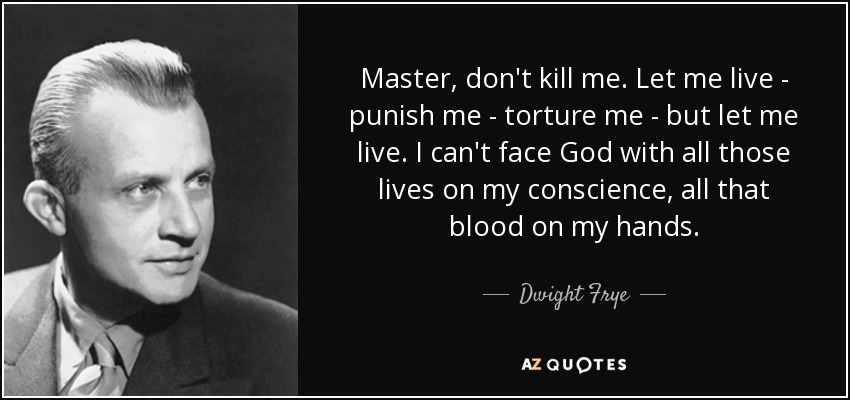
Renfield’s famous quote from Dracula.
Before You Go…
Be sure to check out Guilty Confessions of a Classic Soul, a Spotify playlist dedicated to Monthly Mixtape songs. The playlist will grow with each Monthly Mixtape feature. Don’t forget to follow the playlist so you have it at your fingertips!







 Confessions of a Classic Soul